
 EN
EN
When vehicles operate in extreme climate conditions, the structural and mechanical parts that hold everything together are pushed far beyond their design comfort zones. body components — from panels and frames to suspension-integrated assemblies — absorb the full impact of temperature extremes, moisture, UV radiation, and road stress simultaneously. Understanding these challenges is not just an academic exercise; it is a practical necessity for fleet managers, automotive engineers, and vehicle owners who depend on long-term reliability.
Extreme climates — whether defined by scorching desert heat, sub-zero arctic winters, coastal humidity, or high-altitude UV exposure — each impose a distinct set of stresses on body components. The failure modes differ, the timelines differ, and the maintenance strategies must differ accordingly. This article examines the specific challenges that body components face across these environments and explains why proactive material selection and inspection protocols matter so much in real-world operating conditions.
Thermal Stress and Its Effect on Body Components
How High Heat Degrades Structural Integrity
In desert or tropical climates where ambient temperatures regularly exceed 40°C and road surface temperatures can climb well above 60°C, body components experience continuous thermal cycling. Metal panels expand during the day and contract at night, and this repeated dimensional change gradually weakens joints, seams, and fastener connections. Over time, the cumulative fatigue from thermal expansion and contraction can cause micro-cracking in welds and stress fractures in load-bearing sections.
Polymer-based body components face an equally serious threat from sustained heat. Plastic trim pieces, rubber seals, and composite panels soften under prolonged high temperatures, losing their dimensional accuracy and sealing effectiveness. When seals degrade, moisture and dust infiltrate areas that were previously protected, accelerating corrosion in adjacent metal body components. The interaction between thermal degradation and secondary moisture ingress is one of the most underappreciated failure chains in hot-climate vehicle operation.
Coatings and surface finishes on body components also suffer in extreme heat. Factory-applied primers and topcoats are formulated for a defined temperature range, and sustained exposure beyond that range causes blistering, delamination, and loss of UV-protective properties. Once the protective coating fails, the underlying substrate becomes vulnerable to oxidation at an accelerated rate, shortening the functional lifespan of the affected body components considerably.
Cold Climate Brittleness and Freeze-Thaw Cycles
At the opposite extreme, sub-zero temperatures introduce brittleness into materials that perform adequately under normal conditions. Many plastics and rubber compounds used in body components transition toward a glassy, brittle state below certain threshold temperatures. Impact resistance drops sharply, meaning that minor collisions or road debris strikes that would cause only cosmetic damage in temperate conditions can result in structural fractures in cold climates.
Freeze-thaw cycling is particularly destructive for body components that have any existing surface damage or micro-porosity. Water infiltrates small cracks, freezes, expands by approximately nine percent in volume, and mechanically forces the crack wider. Each cycle deepens the damage, and what begins as a hairline surface scratch can progress to a through-crack in a structural panel within a single winter season. This mechanism is especially relevant for body components made from cast materials or those with complex geometries that trap moisture.
Road salt and de-icing chemicals compound the cold-climate challenge significantly. These substances are highly corrosive and are applied in exactly the conditions — wet, cold, and salty — that accelerate electrochemical corrosion in steel body components. The combination of freeze-thaw mechanical stress and chemical corrosion creates a synergistic degradation pathway that is far more damaging than either factor alone.
Corrosion Challenges Across Humid and Coastal Environments
Salt Air and Electrochemical Corrosion
Coastal environments present a persistent corrosion challenge for body components because salt-laden air deposits chloride ions on all exposed surfaces continuously. Chloride ions are particularly aggressive at breaking down the passive oxide layer that protects steel, initiating pitting corrosion that progresses inward from the surface. Unlike uniform surface rust, pitting corrosion is difficult to detect visually until it has already compromised the structural cross-section of a body component.
Galvanic corrosion is another concern when body components made from dissimilar metals are in contact in a humid, salt-rich environment. The less noble metal in the pairing acts as an anode and corrodes preferentially. This is a common issue in areas where aluminum reinforcements are fastened to steel structures, or where zinc-coated fasteners contact uncoated steel body components. Without proper isolation or protective coatings, galvanic attack can undermine structural connections faster than general surface corrosion.
The undercarriage and lower body components are most exposed to salt spray and road splash, but the problem does not stop there. Salt-laden moisture wicks into enclosed cavities, door sills, and box sections through drainage holes and seam gaps. Once inside these enclosed spaces, the moisture is slow to evaporate, creating a persistently wet environment that sustains corrosion activity even between rain events or road salt applications.
High Humidity and Condensation Effects
In tropical and subtropical climates where relative humidity regularly exceeds 80 percent, body components face a different but equally serious corrosion profile. High ambient humidity means that condensation forms on cool metal surfaces whenever temperature differentials exist — such as early morning or after rain. This condensation provides the electrolyte layer necessary for electrochemical corrosion to proceed, even in the absence of direct water contact.
Organic growth is an additional concern in persistently humid environments. Mold, mildew, and biological films can establish themselves on body components with textured or porous surfaces, particularly on rubber seals, fabric-backed panels, and underbody coatings. These biological films retain moisture against the substrate and can produce organic acids that accelerate surface degradation. Managing biological fouling is a maintenance consideration that is rarely discussed but genuinely relevant for body components in tropical operating environments.
Electrical and electronic components integrated into modern body components — sensors, actuators, wiring harnesses, and control modules — are especially vulnerable to high humidity. Moisture ingress into connectors causes oxidation of contact surfaces, increasing resistance and causing intermittent faults. In severe cases, condensation inside sealed electronic housings can cause short circuits that damage both the electronic component and the surrounding body components through heat or arcing.
UV Radiation and Oxidative Degradation
Surface Finish Deterioration Under Prolonged UV Exposure
Ultraviolet radiation is a significant degradation driver for body components in high-altitude environments, equatorial regions, and any location with high solar intensity and low cloud cover. UV photons carry enough energy to break the polymer chains in paint binders, clear coats, and plastic substrates, causing a process called photo-oxidation. The visible result is chalking, fading, and loss of gloss on painted body components, but the structural consequence is a weakened surface layer that no longer provides adequate protection to the substrate beneath.
Plastic body components are particularly susceptible to UV-induced degradation. Unpigmented or lightly pigmented polymers absorb UV energy efficiently and undergo chain scission, which reduces molecular weight and causes embrittlement. Bumper covers, mirror housings, trim strips, and other exterior plastic body components can become brittle and prone to cracking after sustained UV exposure, even if they have never experienced mechanical impact or thermal extremes.
The degradation of UV-protective additives in coatings is a cumulative process. Most factory coatings incorporate UV stabilizers and absorbers that sacrifice themselves to protect the underlying material, but these additives are consumed over time. Once depleted, the rate of photo-oxidative damage accelerates sharply. This is why body components that appear in good condition for the first several years in a high-UV environment can deteriorate rapidly once the protective additive reservoir is exhausted.
Thermal-UV Synergy in Desert Conditions
In desert environments, UV radiation and extreme heat act together on body components in a way that is more damaging than either factor in isolation. High temperatures accelerate the chemical reaction rates of photo-oxidation, meaning that UV damage progresses faster at 50°C than at 20°C. Simultaneously, the thermal softening of polymer matrices makes them more susceptible to UV-induced chain scission, creating a feedback loop where heat and UV radiation mutually amplify each other's degradation effects.
Dark-colored body components absorb more solar radiation and reach higher surface temperatures than light-colored ones, making color selection a genuine engineering consideration in desert climates. Black or dark-colored plastic body components can reach surface temperatures 20 to 30°C above ambient in direct sunlight, pushing them well into the range where thermal softening and accelerated UV degradation occur simultaneously. This is a practical factor that fleet operators in high-solar-intensity regions should account for when specifying vehicle configurations.
Mechanical Stress from Climate-Driven Road Conditions
Rough Road Surfaces and Vibration Fatigue
Extreme climates often produce road surfaces that impose severe mechanical stress on body components. In cold climates, freeze-thaw cycles destroy road surfaces rapidly, creating potholes, frost heaves, and uneven pavement that generate high-amplitude vibration inputs. In hot, arid climates, thermal expansion and contraction of road surfaces creates cracking and surface irregularities. Both conditions transmit vibration energy through the suspension and into the body structure, subjecting body components to continuous fatigue loading.
Vibration fatigue is a cumulative damage mechanism that operates below the yield strength of the material. Each vibration cycle causes a small increment of damage at stress concentration points — holes, notches, welds, and section changes — and after enough cycles, a fatigue crack initiates and propagates. Body components with complex geometries or multiple attachment points are particularly vulnerable because stress concentrations are inherent in their design. In vehicles operating on rough climate-damaged roads, the fatigue life of body components can be a fraction of what it would be on smooth surfaces.
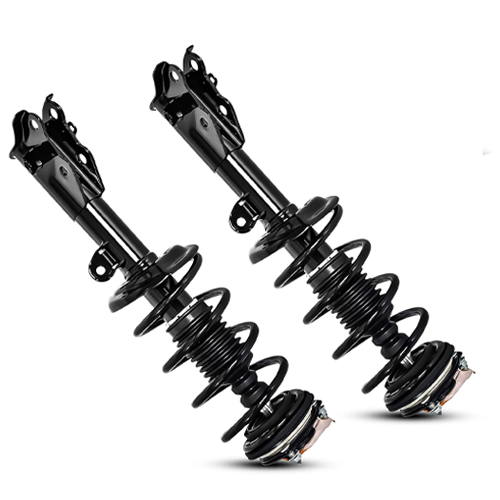
Suspension-integrated body components, such as strut towers, subframe mounting points, and shock absorber housings, are at the intersection of vibration input and structural load transfer. These areas experience the highest stress amplitudes and are therefore the most fatigue-critical locations in the body structure. Regular inspection of these areas is essential for vehicles operating in climates that produce poor road conditions, as fatigue cracks in these locations can compromise vehicle handling and safety if left unaddressed.
Thermal Road Debris and Impact Damage
Hot climates with loose road surfaces generate significant stone chip and debris impact on body components. Gravel roads, construction zones, and deteriorated asphalt surfaces project debris at high velocity against lower body panels, underbody coatings, and wheel arch liners. Each impact removes a small amount of protective coating, and the cumulative effect of thousands of impacts over a season creates extensive bare metal exposure that is highly susceptible to corrosion.
In cold climates, the combination of road salt and abrasive grit used for traction creates a particularly aggressive impact and chemical environment for lower body components. The grit acts as an abrasive that mechanically removes protective coatings, while the salt simultaneously attacks the exposed substrate. This dual mechanism means that lower body components in cold, salted road environments require more frequent inspection and protective treatment than those in other climate types.
FAQ
Which body components are most vulnerable in extreme cold climates?
In extreme cold, the most vulnerable body components are those made from rubber or polymer materials, such as seals, bumper covers, and plastic trim. These materials become brittle below their glass transition temperature and are prone to cracking under impact. Metal body components in enclosed cavities are also at high risk due to freeze-thaw cycling and road salt exposure, which combine to accelerate corrosion in areas that are difficult to inspect and treat.
How does humidity affect the lifespan of body components?
High humidity accelerates corrosion of metal body components by providing the electrolyte layer needed for electrochemical reactions to proceed. It also promotes condensation in enclosed cavities, biological growth on porous surfaces, and moisture ingress into electrical connectors integrated into body components. In persistently humid environments, the effective service life of unprotected or inadequately coated body components can be significantly shorter than in dry climates, making regular inspection and protective coating maintenance essential.
Can UV radiation alone cause structural failure in body components?
UV radiation alone is unlikely to cause immediate structural failure in metal body components, but it can cause significant structural degradation in polymer-based body components over time. Photo-oxidation embrittles plastics and degrades protective coatings, removing the barrier that prevents moisture and chemical attack on the underlying substrate. Once the coating system fails due to UV degradation, the rate of corrosion and mechanical deterioration in the affected body components accelerates substantially, eventually leading to structural compromise if not addressed.
How often should body components be inspected in extreme climate conditions?
In extreme climate conditions — whether hot and arid, cold and salted, or coastal and humid — body components should be inspected at least twice per year, with additional checks after severe weather events or extended off-road operation. Inspections should focus on coating integrity, seam and joint condition, corrosion initiation at stress concentration points, and the condition of rubber and polymer components. Early detection of degradation in body components allows for targeted repair before damage progresses to the point where structural replacement is required.